An unmistakable swell of noise began to reverberate around Crisler Center with a little over a minute remaining on Sunday afternoon, the legions of Michigan faithful understanding that another iteration of the rivalry with Michigan State was about to go their way.
The Wolverines’ lead swelled to seven before the last-ditch foul fest began. They added 11 more points from the free-throw line to ensure that nothing about the waning moments invited doubt. And when Michigan star Yaxel Lendeborg got subbed with 54.5 seconds remaining — having already poured in a game-high 27 points, his second-highest scoring output of the season — he lifted his jersey toward the adoring crowd and screamed in delight.
Everything about the conclusion of the Wolverines’ eventual 90-80 victory that pushed their record to an incredible 28-2 overall and 19-1 in the Big Ten would feel oh, so sweet.
Here are my takeaways:
1. Dusty May and Michigan have seized control of the in-state rivalry

Michigan coach Dusty May cuts down a net after winning the Big Ten regular season title. (Photo by Gregory Shamus/Getty Images)
With an 83-71 win over the seventh-ranked Spartans on Jan. 30, coupled with Sunday’s victory in which Michigan never trailed over the final 12 minutes, the Wolverines might finally be turning the tide of a rivalry that has favored Michigan State for the entirety of the 21st century.
Led by Hall-of-Fame coach Tom Izzo, whose tenure in East Lansing has now spanned the careers of six counterparts at Michigan — from Steve Fisher and Brian Ellerbe, to Tommy Amaker and John Beilein, to Juwan Howard and Dusty May — the Spartans largely owned their maize and blue neighbors.
Michigan State entered this weekend having won 33 of the last 50 games against the Wolverines and hadn’t endured a multi-game, regular-season sweep by Michigan since the 2013-14 campaign, a streak that is now over. Even Beilein, who is among the candidates for greatest coach in program history, finished with a 9-14 record against Izzo.
Though Michigan State won both of last year’s meetings, the offseason brought what felt like a potential changing of the tide. May and the Wolverines dominated the transfer portal by luring stars like Lendeborg, Morez Johnson Jr. and Aday Mara to the program, all of whom are potential first-round picks in the 2026 NBA Draft. Michigan was reportedly among the rarified air of college basketball’s $10 million club — a small collection of teams with the highest-priced rosters in the sport. May and his staff embodied the modern approach.
Fast-forward to the present and Michigan is unquestionably among the best three or four teams in the country, entrenched as a No. 1 seed in the NCAA Tournament thanks to a dominant regular season that was the best in program history. The Wolverines had more size than Michigan State, more speed, more athleticism, more depth and more high-end talent. In some respects, it’s a credit to Izzo that both matchups finished as closely as they did considering just how brutally Michigan dismembered most of its Big Ten foes.
Fans can spend the next few months contemplating if this represents a legitimate changing of the in-state guard.
2. Yaxel Lendeborg’s perimeter shooting is vital for Michigan without L.J. Cason

Yaxel Lendeborg #23 of the Michigan Wolverines reacts after a second half 3-pointer against Michigan State. (Photo by Gregory Shamus/Getty Images)
When backup point guard L.J. Cason suffered a torn ACL during Michigan’s victory over then-No. 10 Illinois last month, the Wolverines lost their most potent perimeter shooter off the bench.
Cason, who originally committed to May at Florida Atlantic before flipping to Michigan, was shooting a team-best 40.2% from beyond the arc among players with at least 20 attempts. He’d made at least two 3s in 10 different games, including a season-high four triples during a victory over Minnesota on Feb. 24 that clinched at least a share of the Big Ten title for the Wolverines.
Without Cason’s scoring punch and perimeter potency, the inconsistent 3-point shooting from Lendeborg, the presumptive Big Ten Player of the Year, comes under an even more intense microscope. Lendeborg entered the game with Michigan State having attempted 4.4 triples per game, though he was only making 32.1% of them. He endured a particularly unsightly stretch from Dec. 21 through Feb. 11 — 14 games — in which he only made nine of 50 attempts, a lowly 18% clip.
What Lendeborg did on Sunday, making five of his six attempts from beyond the arc and eight of 12 shots overall, is exactly what Michigan will need sans Cason in the postseason. It marked the third consecutive outing and sixth game in the last seven when Lendeborg buried at least two 3-pointers. He exceeded 20 points for just the third time since Dec. 13.
3. Bench production remains concerning for Michigan State as the postseason nears

Kur Teng #2 of the Michigan State Spartans shoots against Yaxel Lendeborg #23 of the Michigan Wolverines. (Photo by Aaron J. Thornton/Getty Images)
The game was tied 61-61 with 11:01 remaining when the disparity in bench production between Michigan State and Michigan reared its ugly head. In that moment, the Spartans had only manufactured six bench points, all of which were scored by backup guard Kur Teng on perimeter jumpers. His fellow reserves on head coach Tom Izzo’s bench — Cam Ward, Denham Wojcik and Jesse McCulloch — had combined for zero points on 0-for-2 shooting.
In some respects, this is a narrative that has followed Michigan State all season, considering the Spartans rank 171st nationally in bench points at 21.7 per game. It was clear that Izzo’s core four of Jeremy Fears Jr. (22 points), Jaxon Kohler (23 points), Carson Cooper (19 points) and Coen Carr (six points) could largely be counted on for consistent production night in and night out. But any contributions from the other Spartans were flickering at best and absent at worst — even as the calendar turned to March.
The difference between Michigan State’s uncertainty and the firepower at May’s disposal quickly became apparent down the stretch.
Over the ensuing four minutes, Michigan surged in front courtesy of a 10-3 spurt in which every point was supplied by someone off the bench. Roddy Gayle Jr. (15 points) sliced down the right side of the lane for a short bucket. Trey McKenney (12 points) buried two 3-pointers and added two free throws in between. And suddenly, in what felt like a flash, the Wolverines built a three-possession lead that they never surrendered. Nobody from the Spartans’ bench contributed another field goal.
By game’s end, Michigan had finished plus-21 in bench points.
4. Physicality and extracurricular activity contribute to sloppy start
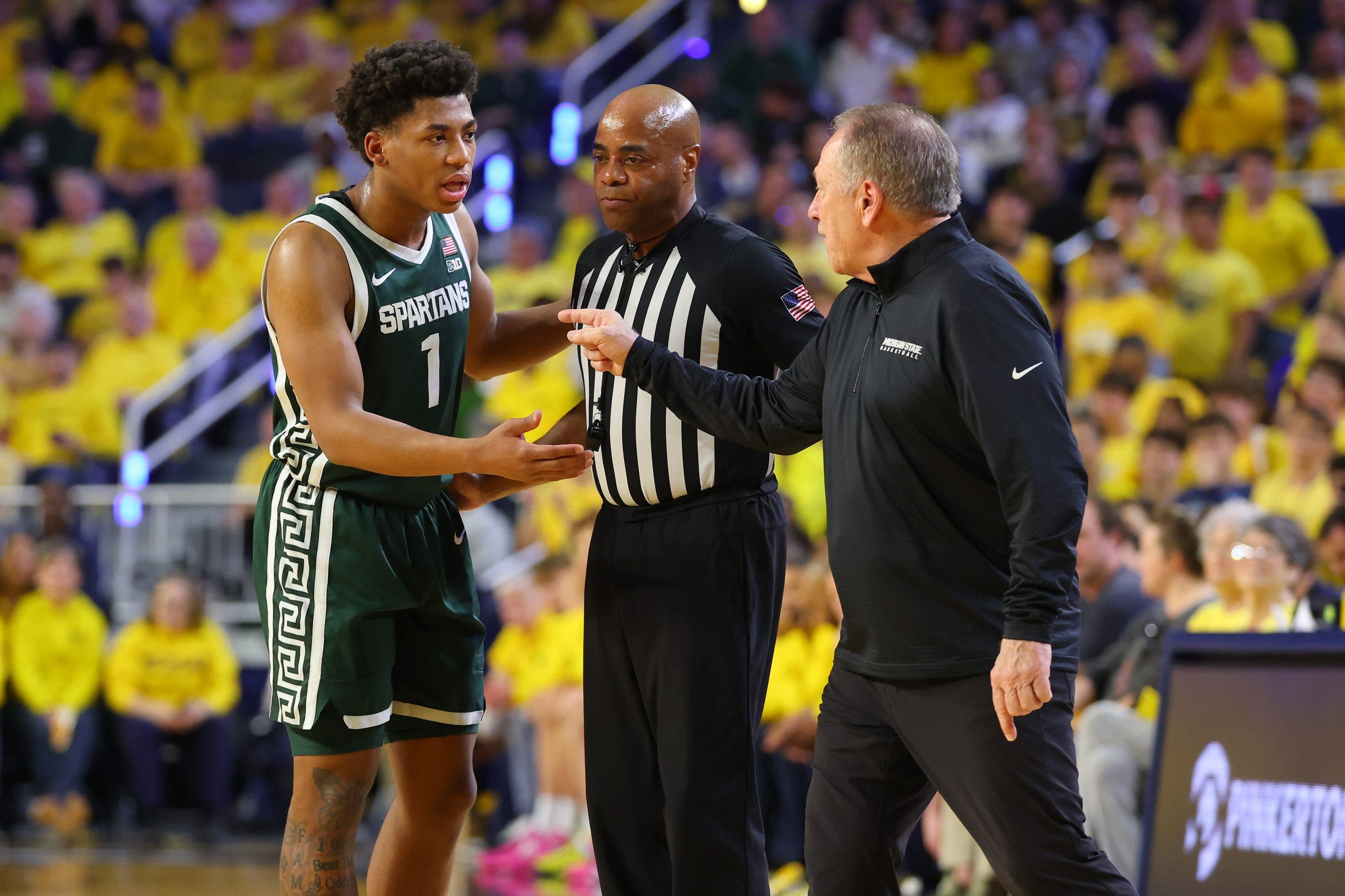
Michigan State guard Jeremy Fears Jr. talks to a referee along with coach Tom Izzo after he was called for a technical foul. (Photo by Gregory Shamus/Getty Images)
[Jeremy Fears T’d Up For Kick Toward Groin]
Durante una pausa temprana con los medios, May se detuvo para una entrevista en la que se le preguntó sobre la “diversión” que empañó los primeros 10 minutos del domingo por la tarde. May, que apenas se anduvo con rodeos, le dijo al periodista que esperaba que en algún momento estallara un verdadero partido de baloncesto, un marcado contraste con la lucha real que había presenciado hasta ahora.
En ese momento, Fears recibió una falta técnica en el minuto 14:24 por patear su pie derecho en la ingle del oponente Elliott Cadeau. Fue la segunda vez en tantos juegos contra Michigan que Fears, quien lidera la nación con 9.1 asistencias por juego, se vio envuelto en una controversia. Su feroz ataque contra Lendeborg en una rápida carrera le valió una falta deliberada en el primer partido entre estos equipos. También realizó un contraataque similar a la ingle de Langston Reynolds de Minnesota a principios de esta temporada. Un cartel en la sección de estudiantes de Michigan dice “Jeremy Fears DPOY – Jugador más sucio del año”.
Hubo más faltas técnicas contra Mara por empujar a un oponente mientras intentaba un contraataque y McKenney por alejar el balón en un intento de pase en el área de los Spartans. Los árbitros parecían tener que visitar la pantalla cada pocos minutos para revisar el vídeo, y todo el cuerpo técnico pedía faltas flagrantes en un momento u otro.
Cuando finalmente se resolvió el alboroto y la animosidad, hubo nueve faltas de Michigan State y ocho faltas de Michigan en la primera mitad. Los Wolverines disfrutaron de una ventaja de más 4 en intentos de tiros libres y acertaron los 12 tiros que realizaron desde la línea. La esquina de un 3 Ese es el dinero de Burnett. faltando 15 segundos para el final, el equipo de May tenía una ventaja de un punto al descanso.
4½. ¿Qué sigue?
No hay mucho en juego para Michigan aparte del feroz orgullo del estado en la final del domingo. Los Wolverines ganaron el título absoluto de la temporada regular del Big Ten al derrotar al entonces No. 10 Illinois el 27 de febrero, lo que les garantizó el puesto número uno en el torneo de la conferencia de este año, y han elaborado un currículum lo suficientemente sólido como para ganarse un lugar en la cima de la clasificación del torneo de la NCAA. Sin embargo, su batalla de ida y vuelta aún continúa con Duke clasificado en el primer lugar para el puesto número 1 general de cara a la Selección del Domingo. Derrota cara a cara ante los Blue Devils el mes pasado disminuyendo las posibilidades de Michigan a menos que Duke tropiece en el Torneo ACC de esta semana.
Para el estado de Michigan, sin embargo, los escenarios tienen más matices. Izzo y su equipo saben que ingresarán al torneo de la conferencia no peor que el puesto número 3, pero los Spartans todavía tienen mucho camino por recorrer para ganar el puesto número 2 según lo que suceda en Crisler Center y en varios otros juegos alrededor del torneo. Pero la victoria del No. 9 Nebraska sobre Iowa el domingo por la noche permitió a los Cornhuskers superar a Michigan State en el orden jerárquico. El equipo de Izzo será el tercer puesto en el Torneo Big Ten.